
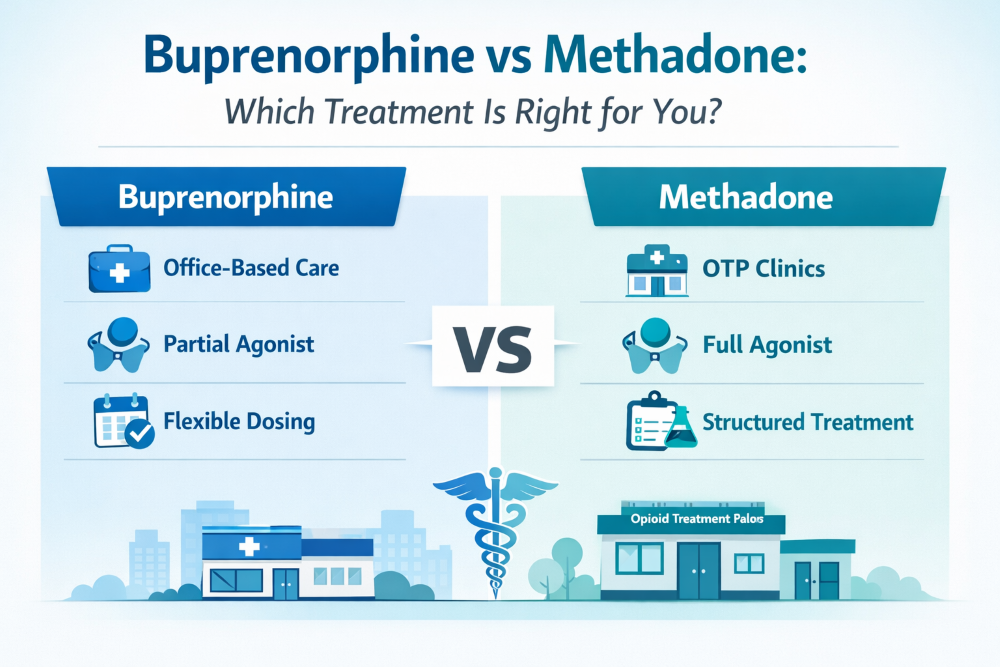
Buprenorphine vs Methadone: Which Treatment Is Right?
The opioid crisis continues to challenge communities across the United States. The CDC reported over 107,000 estimated drug overdose deaths in 2023, though some preliminary reports placed the figure near 110,000. While provisional data for 2024 suggests a significant decrease in these fatalities—with estimates dropping by nearly 27%—opioid use disorder (OUD) remains a major public health concern. Effective, evidence-based treatment remains critical.
Medications for opioid use disorder (MOUD) are among the most effective tools in modern medicine. Research consistently shows that both buprenorphine and methadone significantly reduce overdose risk (by up to 76% in some studies) and improve long-term stability. Yet millions of individuals who could benefit from treatment remain without access; NIDA notes that fewer than 1 in 5 people with OUD are treated with these medications.
If you are considering treatment, understanding the differences between buprenorphine and methadone can help you make an informed decision in consultation with a qualified healthcare provider.
What Is Opioid Use Disorder?
Opioid use disorder is a chronic medical condition involving changes in brain circuitry related to reward, stress, and self-regulation. Like other chronic illnesses, it often requires long-term management.
Both buprenorphine and methadone are FDA-approved and endorsed by major medical organizations, including:
- The American Society of Addiction Medicine: Clinical Guidelines | National Practice Guidelines
- The World Health Organization: Opioid Overdose Fact Sheet
- The National Institute on Drug Abuse: Medications for Opioid Use Disorder
- The Substance Abuse and Mental Health Services Administration: Substance Use Disorder Treatment Options
Buprenorphine: Flexibility and Office-Based Access
How Buprenorphine Works
Buprenorphine is a partial opioid agonist, meaning it activates opioid receptors but only partially. This results in:
- Reduced cravings
- Relief from withdrawal
- Lower overdose risk due to a “ceiling effect”
- High receptor affinity that blocks other opioids
Its ceiling effect reduces the risk of respiratory depression compared to full opioid agonists.
Access and Telehealth Expansion
Following the elimination of the federal X-waiver requirement in 2023, buprenorphine can be prescribed by any licensed clinician with standard DEA registration.
This policy shift significantly expanded access through:
- Primary care offices
- Community health centers
- Hospitals
- Telehealth platforms
Telehealth expansion has particularly benefited rural populations, where daily travel to treatment centers may previously have been impractical or impossible.
Formulations
- Sublingual tablets or films (often combined with naloxone)
- Monthly extended-release injections (e.g., Sublocade)
- Long-acting implants (e.g., Probuphine)
These options allow for flexibility and individualized treatment planning.
Methadone: Structured Stability and Retention
How Methadone Works
Methadone is a full opioid agonist, meaning it fully activates opioid receptors. This can provide:
- Strong suppression of cravings
- Elimination of withdrawal
- Stabilization for individuals with high opioid tolerance
Side-by-Side Comparison
| Feature | Buprenorphine | Methadone |
|---|---|---|
| Medication Type | Partial opioid agonist | Full opioid agonist |
| Access Point | Office-based / Telehealth | Certified OTP clinics |
| Visit Frequency | Often monthly after stabilization | Initially daily; take-home increases over time |
| Safety Profile | Ceiling effect lowers respiratory risk | Requires careful induction monitoring |
| Retention Rates | Effective, though some studies show higher early attrition |
Often demonstrates higher long-term retention in structured settings |
Comparative Effectiveness: Treatment Retention
- Dose adequacy: Ensuring the medication level is sufficient to manage withdrawal.
- Access barriers: Geographic and financial hurdles to obtaining care.
- Social stability: Housing and employment security.
- Support integration: Incorporating counseling and peer support into the recovery plan.
Higher-dose buprenorphine (24 mg or greater) has been associated in recent NIDA-supported research with improved treatment retention and reduced emergency service utilization.
There is no universally superior medication. The most effective treatment is the one an individual can access and remain engaged with over the long term.
- Overdose Risk: Patients receiving either treatment are 50% or more less likely to die from an opioid-involved overdose compared to those not receiving medication.
- All-Cause Mortality: Clinical data show substantial reductions in all-cause mortality during treatment, though some studies suggest buprenorphine may have a slightly lower overall death rate during the first four weeks of induction compared to methadone.
- Methadone Accumulation: Methadone is a full opioid agonist with a long, variable half-life (hours). Because it persists in the body longer than its analgesic effects, it can accumulate to toxic levels with continuous dosing, making careful titration essential during the first two weeks.
- Buprenorphine Ceiling Effect: As a partial agonist, buprenorphine has a "ceiling effect" on respiratory depression. This means that beyond a certain dose, its impact on breathing plateaus, offering a significantly wider safety margin against fatal overdose than full agonists like methadone or fentanyl.
- Secondary Risks: Methadone carries a specific risk of QTc interval prolongation, which can lead to life-threatening cardiac arrhythmias.
- Methadone: Generally restricted to highly regulated Opioid Treatment Programs (OTPs). Patients typically must visit a clinic daily for supervised dosing during the early phases of treatment.
- Buprenorphine: Can be prescribed by qualifying practitioners in office-based settings and picked up at standard pharmacies for at-home use. Recent federal changes have removed the "X-waiver" requirement, further expanding access through primary care and telehealth.
Fentanyl Considerations
The modern drug supply increasingly contains illicit fentanyl and synthetic analogs. According to the latest CDC Overdose Data, while overdose deaths have begun to decline from record peaks, synthetic opioids remain a primary driver of the crisis. Both buprenorphine and methadone remain effective in the fentanyl era, though methadone’s full-agonist properties may provide stronger craving suppression for individuals with very high opioid tolerance. Individual assessment is essential.
Quality of Life and Personalization
Choosing between medications depends on multiple personal factors, including medical history and recovery goals. While SAMHSA’s Buprenorphine Overview highlights its flexibility for office-based treatment, a recent JAMA Retention Study found that methadone is associated with superior treatment retention, even as fentanyl dominates the supply. Furthermore, NIDA High-Dose research suggests that higher doses of buprenorphine may be necessary to improve outcomes for those exposed to high-potency synthetics. Personalization—not ideology—should guide decision-making.
Barriers to Access
- Geographic Inequities: Methadone clinics are unevenly distributed, particularly in rural regions.
- Insurance and Utilization Management: Although coverage has improved, prior authorization and other insurance barriers persist.
- Workforce Capacity: Despite regulatory improvements, provider shortages remain.
- Reduce isolation
- Improve accountability
- Strengthen long-term recovery capital
Questions to Ask a Provider
- Which medication fits my medical history and opioid tolerance?
- What does induction look like under the latest guidelines?
- How often will visits be required?
- What are the total costs and insurance requirements?
Buprenorphine and methadone are medical tools, not competing ideologies. Remaining engaged in treatment dramatically improves stability and reduces overdose risk. The most important step is starting care.
Recent Posts
-
Buprenorphine vs Methadone: Which Treatment Is Right?
The opioid crisis continues to challenge communities across the United States. The CDC reported over …Feb 26th 2026 -
Why Adulterant Panels Matter: Enhancing Integrity in Drug Test Cups and Dip Cards
Detailed Overview of Urine Adulterants Introduction: The Importance of Adulterant Panels in Drug Tes …Jun 4th 2025 -
UScreen® Oral Plus 16 Panel Saliva Flip-Top Cube: Unmatched Coverage, Accuracy, and Ease of Use
Employers and organizations continue to shift toward oral fluid drug testing for its sp …May 28th 2025